Difference between tsuki and uchi.
In essence, think of a tsuki as a direct stab or thrust, while an uchi is more of a swing or a chop. While the term tsuki is often used colloquially to mean "punch," understanding its root meaning of "thrust" helps to differentiate it from the broader category of uchi or "strikes."
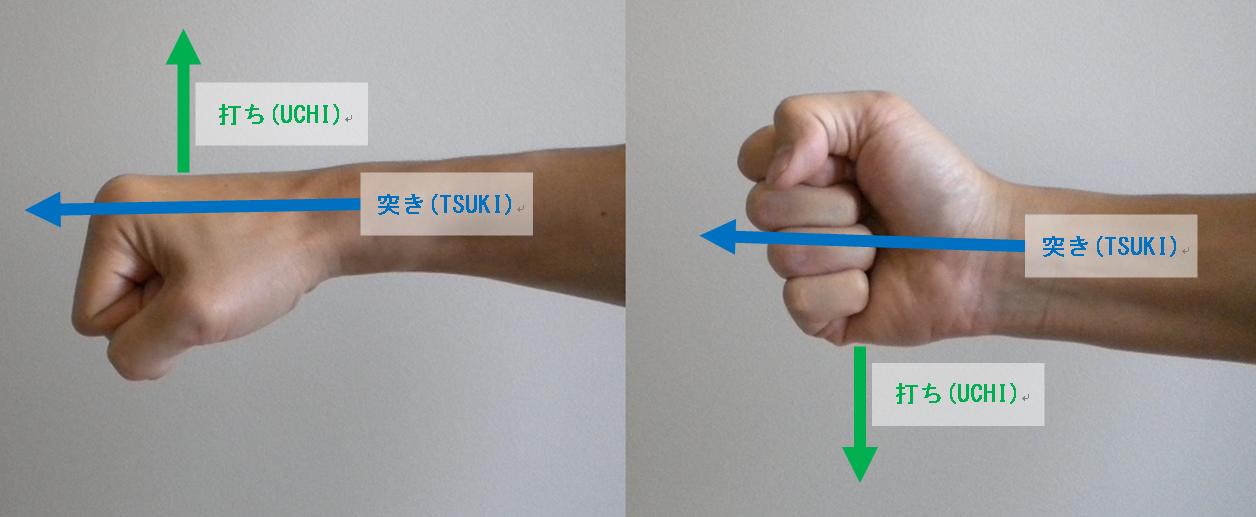
In Uechi-ryu karate, the distinction between Tsuki (突き) and Uchi (打ち) aligns with the general karate definitions, but with specific Uechi-ryu characteristics and emphasis:
-
Tsuki (突き) - Thrust/Punch in Uechi-ryu:
- Emphasis on Direct Thrust: Tsuki in Uechi-ryu still refers to direct, linear thrusting techniques.
- Striking Surfaces: While the seiken (two-knuckle fist) is used, Uechi-ryu is particularly known for its unique tsuki variations:
- Shoken-zuki (小拳突き): The one-knuckle punch, specifically using the second knuckle of the index finger. This is a very characteristic tsuki in Uechi-ryu, emphasized for its focused power.
- Nukite (貫手突き): The spear-hand strike, a thrusting technique with extended fingertips, is also classified under tsuki as a piercing thrust.
- Movement: The tsuki techniques aim for direct penetration, often incorporating the strong stances and body conditioning of Uechi-ryu to generate power behind the thrust.
-
Uchi (打ち) - Strike/Hit in Uechi-ryu:
- Circular and Whipping Motions: Uchi techniques in Uechi-ryu involve more circular, whipping, or percussive strikes, often utilizing the unique hand shapes of the style.
- Striking Surfaces: Uechi-ryu features a variety of uchi techniques using different parts of the hand:
- Shuto-uchi (手刀打ち): Knife-hand strike, using the outer edge of the open hand. In Uechi-ryu, this can have more scooping or circular motion compared to other styles.
- Uraken-uchi (裏拳打ち): Backfist strike, using the back of the fist.
- Tettsui-uchi (鉄槌打ち): Hammer fist strike, using the bottom of the fist.
- Haito-uchi (背刀打ち): Ridge hand strike, using the inner edge of the open hand. Shotei-uchi (掌底打ち): Palm heel strike, using the base of the palm.
- Kakushiken (隠し拳): "Hidden fist" or "crane beak" strike, using the tips of the bent fingers in a pecking motion.
-
Key Differences in Uechi-ryu:
- Prominence of Shoken-zuki and Nukite: The one-knuckle punch (shoken-zuki) is a very distinctive tsuki in Uechi-ryu, highlighting the focus on concentrated force. Nukite is also a frequently used tsuki for vital point attacks.
- Circular Nature of Some Uchi: While uchi generally implies a non-linear strike, some Uechi-ryu uchi, like the shuto-uchi, can exhibit a more pronounced circular or scooping motion, fitting with the style's "half-hard, half-soft" principle.
- Emphasis on Body Conditioning: Both tsuki and uchi in Uechi-ryu rely heavily on the strong, rooted stances and the development of a conditioned body to maximize the power and effectiveness of the strikes.
-
In summary for Uechi-ryu:
- Tsuki are the direct thrusting techniques, notably the shoken-zuki (one-knuckle punch) and nukite (spear hand), along with the standard fist punch.
- Uchi are the various open and closed-hand strikes that utilize more circular or percussive motions and different striking surfaces like the knife-hand, backfist, hammer fist, and fingertips (kakushiken).
| Tsuki (Thrust/Punch) | Uchi (Strike/Hit) |
|---|---|
| Direct, linear thrust | Circular, whipping, percussive |
| Primarily shoulder extension along a line | Elbow or shoulder rotation as primary pivot |
| Fist (knuckles), fingertips (nukite) | Outer hand, back of fist, bottom of fist, palm heel, elbow |
| Focused, penetrating | Broader, angled, percussive |